
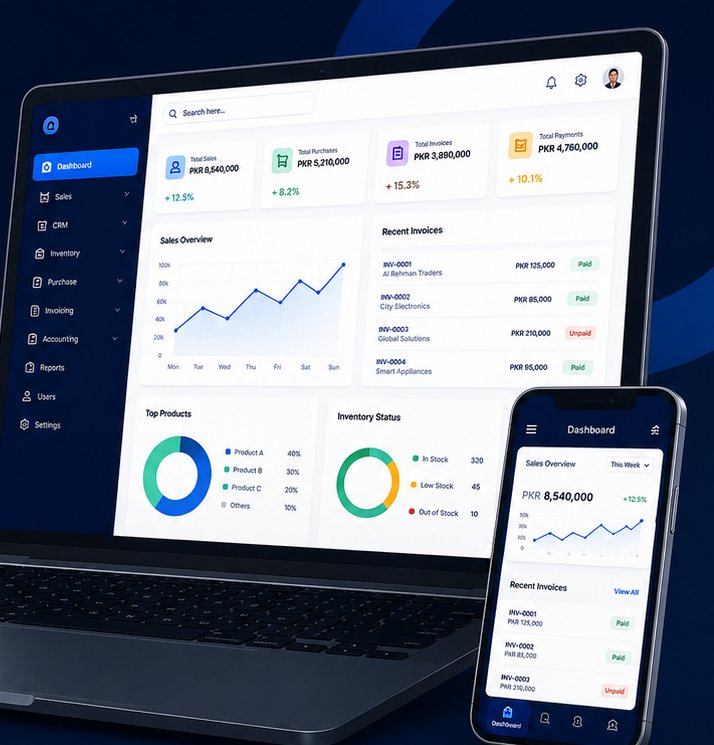
ERP stands for Enterprise Resource Planning. In plain terms, ERP software is a single system that connects the different parts of running a business, inventory, sales, purchasing, production and accounting, so a change in one place updates everywhere else automatically.
Before ERP software, most Pakistani SMEs run each part of the business separately. Stock is counted in a register. Invoices are written in a different app or on a printed pad. Accounts are reconciled by hand at month end, often days after the numbers actually happened. Each system works fine on its own, the problem is that none of them talk to each other.
What ERP software actually does
An ERP system removes the gap between these separate records. When a sale happens, the invoice is created, the customer's ledger updates, and the stock count drops, all from one entry, not three separate ones. When a purchase happens, the supplier's ledger and your stock both update the same way. Nothing has to be re-entered twice, and nothing falls out of sync because someone forgot to update a second spreadsheet.
A simple example
Picture a small distributor selling to twenty retail shops. A sales order comes in, an ERP system checks the current stock automatically, generates the invoice, records what's now owed by that customer, and reduces the stock count, all at the moment the order is confirmed. Without ERP software, each of those four things is a separate manual step, done by a separate person, at a separate time, with plenty of room for a number to be typed wrong or a step to be skipped entirely.
Common ERP modules
Most ERP systems, OP Desk ERP included, are built from a set of connected modules: customers and suppliers, products and stock, quotations and orders, invoices and payments, purchasing, a general ledger, and reports. A business doesn't need to use every module from day one, but having them available in one system means adding a new one later doesn't mean starting a second, disconnected tool.
Why Pakistani businesses need ERP software built for them
A lot of ERP software sold in Pakistan was built for a different market first and adjusted afterward. That usually means PKR and Pakistani tax fields like NTN and STN feel bolted on rather than built in, and the workflows assume a business structure that doesn't quite match how local manufacturers, distributors and wholesalers actually operate. OP Desk ERP was built the other way around: PKR-native reporting and NTN/STN/GST fields from day one, with modules configured around how Pakistani SMEs actually take an order, run a job, and get paid.
Is ERP software only for large companies?
No, and this is probably the most common misunderstanding. ERP software has a reputation for being expensive, complicated enterprise software, because for a long time it mostly was. That's changed. Cloud-based ERP software like OP Desk ERP is priced per company rather than per user or per seat, which means a ten-person manufacturing business pays the same as a fifty-person one, and neither has to install servers or hire IT staff to run it. It's built to be usable by a small team from week one, not just a large enterprise with a dedicated systems department.
How OP Desk ERP fits in
OP Desk ERP is manufacturing and inventory ERP software built specifically for Pakistani manufacturers, textile mills, and distributors. It's cloud-based, so your team logs in from any browser without installing anything, it's configured to your specific business rather than forced into a generic template, and your data is protected with encrypted connections, role-based access, and regular backups. If your business is still running parts of its operation on spreadsheets, a paper register, or a separate invoicing app, that's exactly the gap ERP software is built to close.
The short version: ERP software isn't a single tool, it's a way of connecting the tools you already need, inventory, sales, purchasing and accounting, so they share one accurate set of numbers instead of three or four slightly different ones. For a growing Pakistani SME, that difference tends to show up first in fewer stock surprises, faster month-end closes, and a lot less time spent reconciling numbers that should have matched in the first place.